


Veröffentlicht von ITAMILANO
am 30.07.2026

What if the morning ritual you rely on for clarity is actually a silent architect of damage, stripping away the soul of your hair with every drop? You invest in the finest artisanal treatments and master-level colorists, yet you find your hair remains stubbornly dry, brittle, and devoid of its natural grace. Many clients ask with growing concern, does chlorine change hair color, as they watch their expensive, hand-painted highlights fade into a muted, brassy landscape far too soon. It's a quiet erosion of beauty.
The truth lies in the chemical reality of your water, where chlorine acts as a harsh oxidant that fractures the hair's delicate protein structure and leaches away essential moisture. This article reveals how daily exposure compromises your hair’s integrity, providing the scientific validation your concerns deserve. We will explore how to restore your hair's natural luster and enduring softness through professional-grade filtration, moving beyond temporary masks toward a permanent legacy of health. Excellence begins at the source.
Key Takeaways
- Learn how chlorine acts as a relentless oxidant, dissolving the protective lipid layer of your hair and compromising its structural Longevity.
- Understand exactly how the oxidative process of municipal water answers the question, does chlorine change hair color, by bleaching artificial pigments and stripping natural vibrancy.
- Discover why your daily shower may be more detrimental than an occasional swim, acting as a constant, unseen threat to your hair's architectural integrity.
- Explore the precision of using Vitamin C to chemically neutralize chlorine on contact, a vital ritual for preserving hair softness and health.
- Uncover how Italian-designed multi-stage filtration serves as a permanent solution to restore the luster and heritage of your hair.
The Chemistry of Damage: How Chlorine Alters Hair Structure and Color
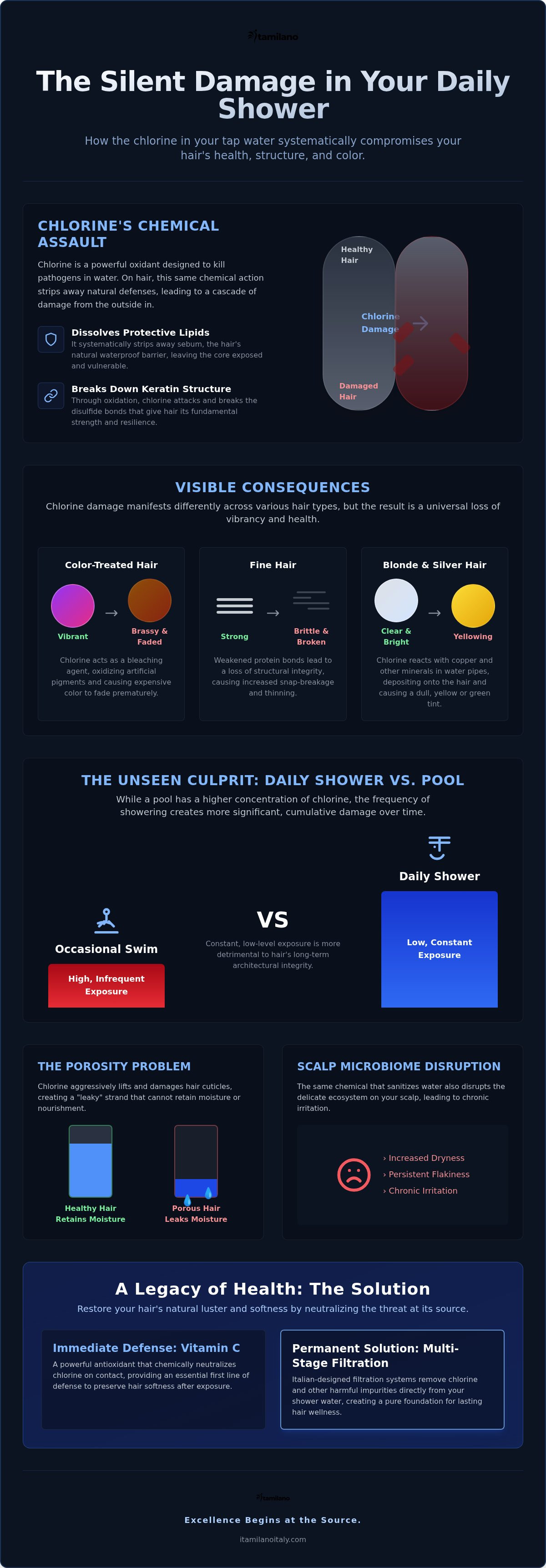
To understand the slow erosion of hair health, one must first look at the chemistry of the water that graces our skin each morning. Chlorine is a formidable oxidant, meticulously utilized in municipal systems to neutralize pathogens and ensure the safety of our shared resources. While its purpose is noble, its interaction with the delicate architecture of a hair strand is often destructive. It acts with a cold precision, dissolving the sebum, which is the protective lipid layer that acts as a natural seal for the hair. Without this artisanal barrier, the hair's core becomes vulnerable and exposed.
The chemical assault continues deep within the fiber through keratin oxidation. This reaction targets the structural proteins, breaking the disulfide bonds that give hair its strength and resilience. When clients ask, does chlorine change hair color, the answer lies in this oxidative power. It doesn't just fade the pigment; it chemically alters it. This often involves a reaction with copper minerals found in older plumbing, creating the infamous green tint that is frequently misattributed to chlorine alone. Understanding the science of pool sanitation helps us realize that the same chemicals meant to protect us in a public bath are present in our homes, quietly compromising our hair's legacy. Quality requires a pure foundation.
The Porosity Problem
Chlorine increases hair porosity by aggressively lifting and damaging the cuticle scales, which should ideally lie flat like the scales of a fine silk garment. This creates a "leaky bucket" effect where the hair may absorb water quickly but lacks the structural integrity to retain it. High porosity caused by chemical oxidation is the permanent lifting and degradation of the hair cuticle that allows internal moisture to escape as quickly as it enters. The hair becomes parched and brittle. It remains unresponsive to even the most luxurious topical treatments because the structure itself is too compromised to hold the nourishment provided.
Scalp Health and the Microbiome
A healthy scalp is a thriving ecosystem, a delicate balance of natural flora and beneficial bacteria that requires protection. Chlorine disrupts this microbiome with the same efficiency it uses to treat municipal water supplies. This chemical interference often leads to chronic irritation, flakiness, or persistent dandruff that resists traditional remedies. When the scalp's foundation is compromised by daily chemical exposure, topical oils frequently fail to penetrate the skin. They simply sit on the surface, unable to reach the damaged layers beneath. True restoration requires a return to purity. It's a commitment to the long-term health of your skin's unique story.
Fading Pigments and Fragile Fibers: Consequences for Every Hair Type
While the chemical erosion discussed previously is a universal threat, the way it manifests depends deeply on the unique tapestry of your hair. For those with color-treated tresses, the question of does chlorine change hair color is not merely academic; it's a visible, daily struggle. Chlorine acts as a relentless bleaching agent that penetrates the hair shaft to oxidize artificial pigments, turning a masterfully crafted brunette into a dull shadow of its former self. It doesn't discriminate based on shade or style. It simply erodes the vibrancy you've worked so hard to achieve.
Fine hair suffers a different, yet equally tragic, fate. As the chemical strips protective lipids and breaks down structural proteins, these delicate strands lose their inner strength. This leads to snap-breakage and a gradual thinning that masks the hair's natural volume. For those with silver or blonde hair, the interaction between chlorine and tap water minerals often results in unrefined yellowing or brassiness. It's a distortion of the hair's true heritage. If you've noticed your rich mahogany turning a strange, metallic orange, you've witnessed firsthand how does chlorine change hair color by altering the very molecules of the dye. It's a slow, quiet theft of beauty.
The Color-Treated Crisis
When you step into the shower, the heat opens the hair cuticle, allowing chlorinated water to rush in and attack the pigment trapped within. This chemical theft means that the artistry of your stylist is quite literally washed away by the very water meant to cleanse you. You may find yourself reaching for toning shampoos or purple masks to correct the damage, but these are merely temporary veils. They cannot replace the structural integrity lost to poor water quality. Choosing a refined solution like an ITAMILANO Handheld Filter Shower ensures your color remains a lasting legacy rather than a fleeting memory. It's an investment in your hair's permanence.
Natural Textures and Resilience
Curly and coily hair types possess a natural beauty defined by their intricate spirals, yet this same structure makes them uniquely vulnerable. The winding path of the hair shaft makes it difficult for natural sebum to travel from the scalp to the ends, leaving the hair inherently drier. When chlorine dissolves what little oil remains, the result is immediate, uncontrollable frizz that resists even the heaviest conditioners. You can distinguish this chemical "straw-like" texture from natural dryness by the way the hair feels brittle and lacks movement. It's the difference between a weathered antique and a well-preserved heirloom. This damage requires a foundational shift in how you treat your water.
The Silent Culprit: Why Daily Shower Water is More Damaging Than the Pool
We often associate the sharp scent of chlorine with the bright blue of a summer afternoon or the structured lanes of a public pool. It's a pervasive misconception that chemical damage is exclusively a "swimmer's problem." In reality, the water that flows through your home is treated with the same necessity to ensure public hygiene and safety. The U.S. Environmental Protection Agency (EPA) sets the maximum residual disinfectant level for chlorine in public drinking water at 4.0 ppm, which is equivalent to 4.0 milligrams per liter. While this concentration protects us from pathogens, it remains present as we wash. It's an invisible guest in every ritual.
The cumulative effect of three hundred and sixty-five showers a year creates a far deeper erosion of hair health than a week of vacation swimming. When a client asks, does chlorine change hair color, they are often searching for a singular event to blame. They don't realize the culprit is the very water they trust for their daily cleansing. The science of how chlorine damages hair reveals that this constant exposure leads to a slow, irreversible degradation of the hair's natural pigment and strength. It's a quiet theft of vibrancy. Quality is built on a foundation of purity, yet our pipes often deliver the opposite.
Desalination and Hair Loss in Urban Centers
In the vibrant urban centers of the UAE, the challenge takes on a more specific regional character. Dubai's reliance on desalinated water requires a meticulous chemical profile to maintain safety across vast distances. This water often carries a high chlorine profile alongside hard water minerals, creating a "double threat" to the hair follicle. Desalinated water mineral content acts as an abrasive force that contributes to hair shaft brittleness, leading to the thinning many residents find so distressing. It's a struggle that transcends simple dryness. It's an architectural failure of the hair strand itself.
Cumulative Bio-Accumulation
Over months of exposure, chlorine and heavy metals build up on the hair fiber, creating a stubborn film that refuses to be rinsed away. Your hair feels heavy and dull, losing the light-reflecting elegance that defines healthy tresses, even after using the most expensive clarifying shampoos. This isn't merely a cosmetic failure; it's a psychological weight. The frustration of "bad hair days" caused by invisible water quality issues can diminish one's sense of self. True beauty requires a commitment to longevity. It demands a solution that addresses the root of the damage rather than masking the symptoms. Restoration begins with the water.
Neutralizing the Threat: Professional Strategies for Hair Preservation
Preserving the architectural beauty of your hair requires a shift from reactive repair to proactive defense. While many spend years searching for topical masks to undo the damage, the true master of hair care understands that excellence begins with the water itself. It's a matter of structural integrity. When individuals notice their vibrant tones fading, they often ask, does chlorine change hair color, yet the answer arrives too late if the water hasn't been neutralized. To protect your hair's legacy, you must adopt a ritual that respects the material as much as the process.
A professional-grade routine in high-chlorine regions should follow a precise sequence to ensure longevity. Consider this checklist for your daily practice:
- Pre-saturate your hair with filtered water before applying shampoo to limit the absorption of chlorinated tap water.
- Utilize a multi-stage filtration system that incorporates Vitamin C to chemically neutralize oxidants.
- Apply pH-balanced products immediately after washing to encourage the cuticle scales to lay flat.
- Seal the hair with a leave-in conditioner to provide a physical barrier against environmental pollutants.
Topical solutions are often mere echoes of a problem that requires a foundational solution. Filtration is the only proactive defense that honors the artisan's work. To begin your journey toward lasting hair health, explore the ITAMILANO Handheld Filter Shower and transform your daily routine into a preservation ritual.
The Power of Vitamin C Filtration
Vitamin C, or Ascorbic Acid, performs a chemical transformation that is nothing short of poetic. It initiates a reaction where aggressive chlorine is turned into a harmless, stable chloride salt on contact. This process is immediate and thorough. Unlike standard carbon-only filters, which often lose their efficacy as water temperature rises, Vitamin C remains steadfast in its precision. It's a sophisticated approach to water purity that results in immediate hair softening and a light-reflecting shine that no synthetic serum can replicate. It's the difference between a temporary fix and a permanent standard of quality.
Post-Shower Restoration
Closing the cuticle is the final seal of authenticity in your hair care routine. Using pH-balanced products helps restore the hair’s natural acidity, which is often disrupted by the alkaline nature of chlorinated water. This step is vital for locking in moisture and protecting the internal cortex. You can monitor your hair's recovery through the elasticity test. A healthy strand should gently stretch and return to its original form. If it snaps under minimal tension, it's a sign that the structural proteins are still recovering from chemical oxidation. Consistency is the hallmark of a true wellness ritual. It's a commitment to the enduring nature of your beauty.
The ITAMILANO Philosophy: Elevating Your Shower into a Hair Wellness Ritual
Transitioning from the science of chemical oxidation to the art of hair preservation requires a tool that respects both the material and the person. The ITAMILANO Handheld Filter Shower is a masterpiece of form and function. It's designed to be the final word in hair health. Many individuals continue to wonder, does chlorine change hair color, while they cleanse with water that is fundamentally flawed at its source. This system employs a sophisticated multi-stage filtration process that removes chlorine, heavy metals, and impurities before they touch a single strand. It's a commitment to purity that honors the artistry of your stylist and the legacy of your hair's natural strength.
Rooted in an ITALIAN heritage established in 2020, our philosophy blends traditional craftsmanship with the precision of modern filtration technology. We understand that a luxury bathroom is a sanctuary. Every element should reflect a commitment to quality. The ITAMILANO Replacement Filter Cartridges ensure that this protection remains consistent for years, providing a shield against the harsh chemical profile of municipal supplies. Longevity is not an accident. It's an intentional design choice that serves those who value the story behind their possessions as much as the objects themselves. Quality is a permanent standard.
Designed for the Modern Home
The ITAMILANO Shower Filter Kit integrates seamlessly into existing luxury plumbing, elevating a mundane task into an extraordinary experience. Unlike the disposable plastic alternatives that often dominate the market, our systems utilize premium brass and stainless materials. There is a tactile reality to high-quality materials that plastic simply cannot replicate. We view this shower head as a companion in your daily wellness and beauty ritual. It's a silent guardian that carries the story of your hair's restoration, ensuring that the question of does chlorine change hair color becomes a concern of the past. It's an investment in a refined sensory experience.
A Commitment to Permanence
Choosing a high-quality filtration system is a one-time investment in your hair's structural future. It's a bold stance against the disposability of modern fashion and a return to the values of artisanal integrity. Maintaining your ITAMILANO system is effortless with our subscription-ready replacement cartridges, which ensure you never have to compromise on water quality again. This consistency is vital in high-chlorine environments, such as those found in urban centers across the UAE, where desalinated water presents unique challenges to hair vitality. True beauty deserves a pure foundation that lasts a lifetime. Experience the allure of pure water with ITAMILANO.
A Legacy of Luster and Structural Integrity
The journey to enduring hair health begins by acknowledging that the water we trust is often the very force that compromises our beauty. We've explored how daily chemical exposure acts as a silent architect of damage, stripping away the protective lipids and proteins that define a healthy strand. For those who have long wondered, does chlorine change hair color, the evidence is clear: the oxidation process is a relentless thief of vibrancy. True restoration isn't found in a temporary mask but in the decision to purify the foundation of your ritual.
By choosing a solution rooted in Italian craftsmanship since 2020, you embrace a standard of excellence that transcends the ordinary. Our advanced multi-stage filtration technology is specifically trusted by residents across the UAE to navigate the unique challenges of desalinated water. It's a commitment to the longevity of your tresses and the preservation of your hair's unique story. You deserve a companion in your wellness journey that values precision and artisanal integrity as much as you do. Now is the time to Protect your hair with the ITAMILANO Handheld Filter Shower and reclaim the natural softness you've been missing. Your hair's future is written in the water you choose today.
Frequently Asked Questions
Does chlorine cause permanent hair loss?
Chlorine doesn't usually result in permanent hair loss, yet its oxidative nature creates a landscape of breakage and thinning that mimics loss. It targets the structural integrity of the strand, causing it to snap under minimal tension. Additionally, the chemical irritation of the scalp's microbiome can hinder the growth of new, vibrant hair. True restoration begins by neutralizing the source of this daily erosion and protecting the follicle's heritage.
How can I tell if my hair has chlorine damage from my shower?
You can identify chlorine damage through a persistent, straw-like texture that resists even the most luxurious topical treatments. If your tresses appear dull or lack their natural light-reflecting grace, it's often a sign of chemical buildup. Many clients first realize the issue when they ask, does chlorine change hair color, as they watch their expensive salon tones turn brassy or muted after just a few weeks of daily showering.
Is a shower filter enough to protect my hair from chlorine?
A professional-grade shower filter is the most effective proactive defense against chemical damage. Standard carbon filters often fail in hot water, but systems utilizing multi-stage filtration with Vitamin C chemically neutralize chlorine on contact. This creates a foundation of purity for your hair wellness ritual. It's an investment in the long-term health of your hair's architecture, ensuring every wash is a preservation of beauty rather than a compromise.
Can I use Vitamin C to remove chlorine from my hair?
Vitamin C is remarkably effective at neutralizing chlorine by transforming it into a stable, harmless chloride salt. While post-shower rinses can help, integrating Vitamin C directly into your filtration system provides immediate protection during the wash. This process prevents the chemical from bonding with your hair's proteins in the first place. It's a sophisticated approach that honors the material and the craft of hair care, moving beyond reactive treatments toward permanent protection.
Does chlorine affect all hair colors the same way?
Chlorine interacts with different pigments with varying degrees of aggression. For brunettes and redheads, it acts as a bleaching agent that answers the question, does chlorine change hair color, by leaching away artificial vibrancy and depth. For those with blonde or silver hair, it often reacts with copper minerals in the water to create an unrefined green or yellow tint. Every shade requires a pure foundation to maintain its intended heritage and brilliance.
How often should I change my shower filter to ensure it still removes chlorine?
To maintain the integrity of your water, you should typically replace your filter cartridges every three to six months. This frequency depends on the volume of water used and the specific chemical profile of your local supply. Consistent replacement is a commitment to the longevity of your hair's health. It ensures that the filtration remains a steadfast guardian against the silent erosion caused by municipal chlorine and heavy metals over months of exposure.
Why does my hair feel like straw after showering in Dubai?
The straw-like texture often experienced in Dubai is a direct result of the high chlorine and mineral profile found in desalinated water. This water is essential for urban safety but is notoriously harsh on the hair's lipid layer. The synergy between these chemicals and hard minerals creates a stubborn film that leaches away moisture and leaves the hair brittle. Restoration requires a refined solution that addresses these specific regional challenges by purifying the water at the source.





























